Monday, July 22, 2013

A Democracy of Scoundrels Part II: Dividing up the Spoils and Electing a Captain

     
     Now a days, nowhere is law more relevant (or more complicated!) than when it pertains to money.  In the days of the Buccaneers, it was no less true, especially when it came to dividing up the spoils of a conquest!  With the spoils often being varied, haphazard dispersal of their gains would surely incite resentment and even violence.  To avoid this, rules were made ahead of time within the Articles on how to reward those who participated in a successful chase.
     In a great sense of camaraderie and fairness, the Articles frequently stipulated that all old debts were to be paid from the common prize before any division of spoils was made.  This would mitigate the possibility of crewmembers accosting each other after the conclusion of the voyage.  If the chase had been successful enough but there were wounded to contend with, the Articles might state that an individual would get extra shares depending on the severity of their injury.  The loss of an eye might net half a share or the loss or mangling of a limb, one full extra share.   
     When it came to the authority of the captain, the Articles might typically afford all crew members the right to hold a meeting to speak against and remove their captain.  In this event, a vote could be taken and a new captain elected if the first captain was deemed unlucky or hadn’t forced them to fight sufficiently or equally.  In this way, a chase party of Buccaneers was much more like a direct democracy than a dictatorship.  The captain was generally afforded few special rights under the Articles except extra shares of the plunder.
     On larger vessels, however, the command structure became a bit more sophisticated and a captain might assert greater powers.  If the captain was deemed lucky over time and his chase parties successful, he might rise to prominence among the men.  His authority would rise with him, in some cases even to fame, as in the case of Henry Morgan, Pierre le Grand and others.  Crewmen tended to aggregate around such personalities who had proven they could deliver wealth and success to those who followed them, thus their authority was less often challenged.  When the crew became too large to manage by the captain himself, he would select a quartermaster whose duty it was to keep the men in line and to inform the captain of any infractions.
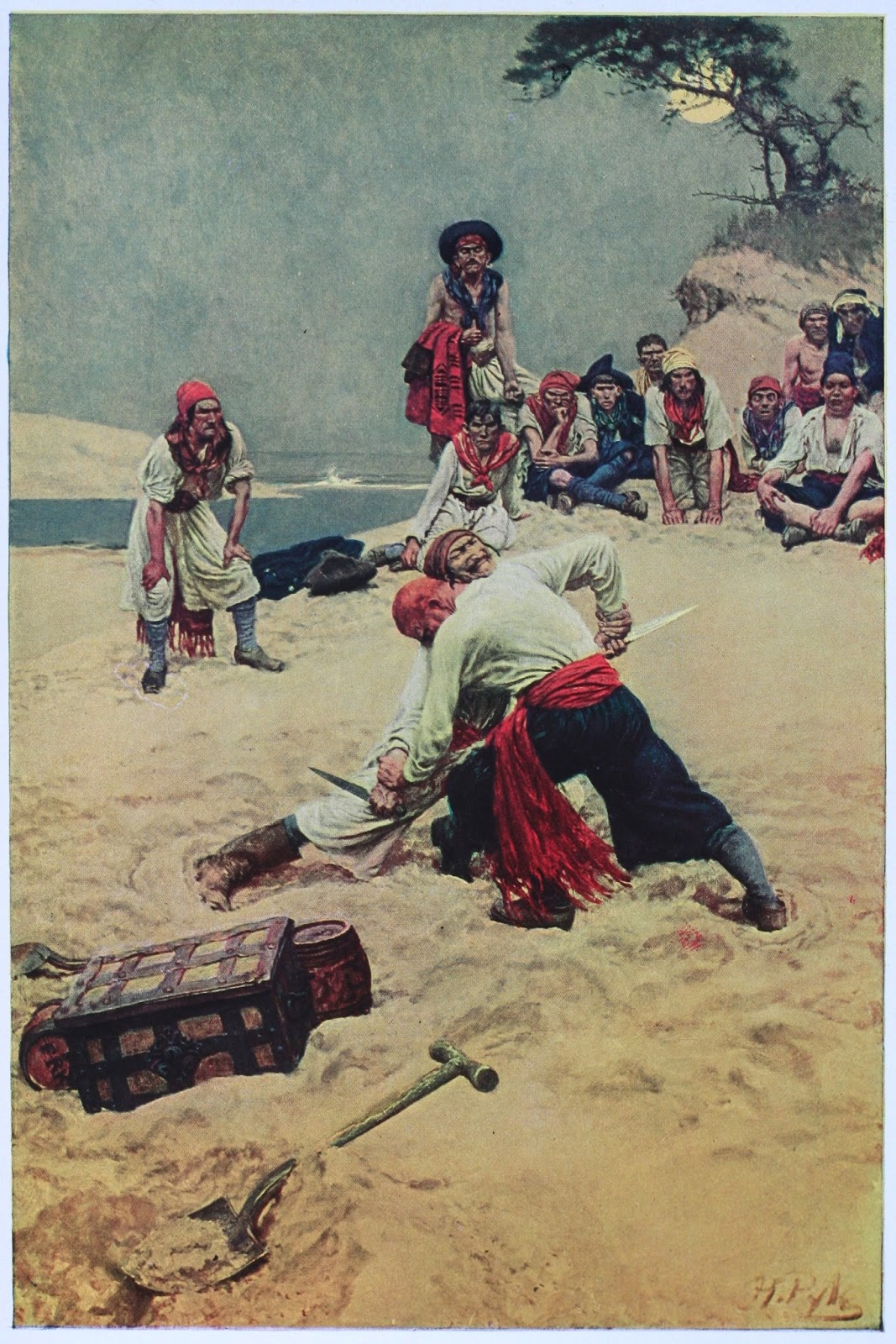
     If anyone was caught violating any of the items in the Articles, punishment was also stipulated in the document.  It was usually as severe as these men treated their Spanish captives.  A man might be marooned on a small island with nothing more than a skin of water and his cutlass, if he was caught robbing another, or was deemed undesirable.  Certain death would almost always follow in such cases.  Even apparently trivial things could be punishable.  Too much idle talk could get your lips sewn together.  Noses might be slit down the middle or an ear cut off, if a man showed disrespect to one of the Articles.  If it couldn’t be ascertained who of two men had been the instigator of an infraction, the Articles might declare ‘pistol to pistol or sword to sword’ with the two of them.  Such severe and capital punishments were necessary to keep otherwise lawless men in line aboard the ship.  Once the hunt for Spanish shipping was over and the men were ashore, however, old grudges could be settled in the usual way.
     When they had disembarked and were away from the rules of the Articles, these corsairs spent their stolen wealth freely in the taverns and stews of the Dutch and French ports of the Windward Antilles.  They understood well the brevity of life in the islands and the New World, aware that misfortune and death could come at any day.  Thus money left unspent may well be money left to waste.  In just a few nights these unrestrained men could lose everything in houses of ill repute, on gambling and in taverns.  Along the way, many a brandy induced argument was settled over crossed swords or knives, leaving the tavern keeper to  hope the loser’s bill was already paid.
     However, upon reaching sobriety again, shoeless and penniless, they were more often then not ready for another adventure beneath the Article's strict discipline. 
     Next week's blog will be:  Tortuga; First Haven of the Buccaneers

For much more on the subject, you can also read my historical novel, The Brethren Prince, available as an e-book at the Amazon Kindle store, Apple iBooks, Barnes and Noble, and other major e-book retailers.

Wednesday, July 17, 2013

A Democracy of Scoundrels, Part I: The Articles of Conduct


     In the 17th Century, in an age where Kings and nobles still ruled the world by virtue of inheritance, egalitarianism emerged in an unexpected place: along the wild coasts of Hispaniola.  The place where Buccaneer hunters scratched out a living on the tattered fringe of civilization.  A place where no nation's laws could yet reach. 
     As is often the case, when men go too long without the structure of society, they create some semblance of society themselves.  Such was the case with the Buccaneers.  Because the Buccaneers consisted of the dregs of western civilization, there were no nobles amongst them who could impose or import rules by virtue of their innate authority (nor would any birthright be enforced, anyway).  Therefore, the creation of makeshift laws was grassroots and came from a show of hands, with no man's opinion being weighted more than any others. 
     The simplest and probably earliest "legal" document among the Buccaneers was known simply as ‘the Articles’.  It was a solemn bond between two men, a serious pledge written out, signed, and probably varied depending on the individual’s situation.  In a lawless place like the northern coast of Hispaniola, it could be helpful in binding two Buccaneer hunters together to protect each other in case of attack by various trespassers.  It also helped to have rules when it came to sharing resources such as residences, clothing, and weapons as well as food stores, and of course income derived from sale of meat and hides.  Above all, the Articles declared that each man would hide nothing from his partner, or brethren.  These concerns were thought out between the two men and numbered in the Articles individually.  Before signing, they would both agree to the terms.  The Articles seemed to have worked well as a common governmental tool, for the idea spread up and down the coast and eventually it involved more than just two men. 
     As larger groups of individuals worked together in chase parties directed at Spanish shipping, the Articles evolved to become a democratic document that everyone should respect and pledge to uphold; a set of laws by which all members have elected, and then to which they must adhere.  Before a sea raid, the Articles were drawn up by an elected captain, and then put to an up or down vote.  Once the crew had signed, it gave the captain the authority to enforce the tenants of the Articles as well as demand that they fight as best they could. 
     There were many rules detailed in the Articles that were common.  For instance, the Articles might insist that there be no gambling while at sea, for it would foster bad feelings with the looser.  The Articles might also insist that there be no smoking, as fire aboard a vessel was every seaman’s dread.  Women were often banned since it was considered bad luck for them to be brought along, though an exception was made if female slaves were captured, for they were too valuable as contraband.  One of the greatest offenses, according to the Articles, was "concealing items from his mates, even the least thing they found among their prey," as the Historian Esquemeling relates.
     But the Articles was not always strictly punitive.  It may include incentives as well.  For instance it might stipulate that if a great prize was captured, every man might have as much to drink as he so chose, if supplies were sufficient. 
     The Articles also determined how loot was distributed.  The crew was given "shares" in the same way stockholders are given stock in a modern company.  Before disembarking after a successful voyage, the loot was totaled as best as was possible then divided up into 'shares'.  The Captain might be entitled to receive up to 5 shares.  "Officers",  like the first mate or quartermaster might get 2 shares.  All other crewmen generally received 1 share each with the exception of boy helpers, who may only get half a share.
     As time went on and the Buccaneer raiders became a force to be reckoned with in the Caribbean, the face of Buccaneers in the Caribbean changed considerably, but the democratic ethic of the Articles persisted.
     Next week, we'll continue with A Democracy of Scoundrel, Part II: Dividing up the Spoils and Electing a Captain.


For much more on the subject, you can also read my historical novel, The Brethren Prince, available as an e-book at the Amazon Kindle store, Apple iBooks, Barnes and Noble, and other major e-book retailers.
Thursday, July 11, 2013

Spices, Silks and Slaves: The Allure of Piracy, Part II


            This week, we explore further the various goods that the Buccaneers of the Caribbean pilfered from their prey.  If you haven't already, read part one of Spices, Silks and Slaves: The Allure of Piracy, Part 1.
            While it might seem odd to many of us today, salt was a highly coveted item in the Caribbean, as it had been throughout the world and human history.  Before the days of refrigeration, not many foods could be kept from spoiling.  Salt, however, is a natural preservative and was used to keep meat from rotting.  Salt in the New World was hacked loose from great piles in Cumana (Venezuela), located on the north coast of South America.  It's no coincidence that this region was referred to as "The Salt Coast."  Naturally, salt was a valuable cargo for Buccaneers to seize.    
            Another valuable resource to come by was Indigo wood from the Orinoco area in South America.  It was prized for the deep blue dye that could be extracted.  It was lumbered from distant forest areas down the Orinoco River, cut into shippable blocks, and transported to the coast.  While it may seem peculiar to imagine a band of Buccaneers celebrating around a shipment of newly captured lumber, Indigo wood would be considered a very fine catch. 
            But inventories from the Americas were not the only treasures that passed through the Caribbean on their way to the ports of Spain and markets of Europe.  Embroidered muslin and fabrics, fine china, silverware, and silks came from China.  Spices like pepper, mustard, ginger, and cinnamon came from Indonesia.  Ivory carvings and combs came from India and China. 
            Every year these exotic goods and many others were shipped across the Pacific to the west coast of Mexico via The Manila Galleon.  They were then carted across the continent to Vera Cruz, where, once a year a great bazaar took place.  Afterward, everything was transported back to Europe via the treasure fleet.          
            All of the goods mentioned so far were some of the more frequent inventories, but there were scores of other items that were produced and traded in smaller quantities, like pearls.  But despite the tremendous wealth that was generated or passed through the Caribbean, the vast majority of goods seized by pirates were not the valuable ones mentioned above but goods that were mundane in nature: provisions like sail cloth, fruit, dried meat, needles, fish, clothing, gunpowder, iron and brass fittings, and all of the other ordinary provisions that made life in the Caribbean possible.  After all, it was the ships that carried these types of items that were most common, least guarded, and most easily captured.      
            Regardless of what the Buccaneers confiscated, they rarely shopped around for buyers when it came to their stolen property.  After a short jaunt from the Windward Passage to Tortuga, they would disembark their stolen cargo and sell it quayside to middlemen and merchants after paying Governor Levasseur’s tax.  Once the spoils were divided, treasure was never buried (a fictitious act for Buccaneers) nor was it saved.  They typically sold or traded everything soon after stealing it, and promptly spent it all in literal orgies of drinking and indulgence of every sort.  It’s because of these flurries of wild spending and brief bouts of high living that Buccaneer havens like Tortuga earned their deserved reputations.
            Though the Buccaneers dreamed of chests full of gold and silver, most would never capture any great quantity until later, when most of them had moved from Tortuga to Port Royal, Jamaica, and put to sea with such devils as Francois L'Ollonais, Christopher Myngs and Henry Morgan.  That’s not to say that vast quantities of gold and silver didn’t pass through the Windward Passage on its way back to Europe.  They certainly did, but these precious metals were transported in Spanish treasure fleets amid dozens of vessels, all jealously guarded by armed war galleons.  Even later, when major cities on the Spanish Main were sacked, the Buccaneers had to divide such spoils many times, since these undertakings required hundreds, even thousands of men.     
          If you enjoyed this blog, join us next week for:  A Democracy of Scoundrels.
For much more on the subject, you can also read my historical novel, The Brethren Prince, available as an e-book at the Amazon Kindle store, Apple iBooks, Barnes and Noble, and other major e-book retailers.

Tuesday, June 25, 2013

Spices, Silks and Slaves: The Allure of Piracy, Part I

           
            Unlike most fictitious portrayals of the early buccaneer exploits, these robbers seldom found great quantities of gold coins or jewel encrusted crucifixes amid Spanish shipping.  Cargoes of full silver and gold did occasionally pass through the Windward Passage, but usually on well guarded galleons within large treasure fleets.  Smaller vessels without armed guards, however, were an easier target, and they typically carried commodities and raw materials.  Though these inventories weren't gold per se, in many cases, were just as good as gold and could be traded easily. 
            As far as is known, the Buccaneers were not pirates in the strictest sense, for they generally steered clear of attacking ships that were not Spanish.  Imperial Spain was regarded as the common oppressor of all other nations in the Caribbean, and most of the New World’s wealth and lands were owned by Spain, making them the most rational target for piracy at the time.
            The variety of these goods was very broad indeed, for Spain’s empire was worldwide.  Its trade routes spread around the Southern tip of Africa, along India and up through the orient, through the Philippines and across the Pacific, back to Central America and up the Caribbean, then finally back to Spain.  Along the way, all sorts of exotic goods were accumulated and, on the last leg of their journey through the Windward Passage, the Buccaneers lay in wait, seizing some of the inventories of this worldwide journey. 
            Cocoa beans were one of the most common and valued of prizes a Buccaneer might find.  Cocoa beans were grown by the Spanish in the lands of Central America, introduced by the Maya, where it had originated as a favorite drink.  Back in Europe, cocoa drink was all the rage, and a shipment of it was as good as gold to the Buccaneers. By the 1650’s after the Buccaneers became more prominent, refined sugar was also a huge prize to be had.
            Right at the top of desired items was also tobacco, which was unknown to Europeans until the Spanish discovered the native Americans burning it in a clay pot they called a ‘tobag’.  They sucked out the smoke through small holes with straws and, needless to say, the unhealthy habit of filling one’s lungs with smoke caught on.  The Spanish dispensed with the large pot and fashioned a smaller pot at the end of a clay straw to hold the dried weed and thus the pipe was born.  By 1600 this rather calming narcotic had become so popular that the English King James I declared that he did not trust any man who would not engage in ‘a smoke of good cheer with his fellows’.  With endorsements like these from Europe’s monarchs, one can imagine how valuable bales of dried tobacco leaves might be.
            But there was one good that might be seized by Buccaneers that was more valuable than any other, pound for pound.  That cargo was human slaves.  Though it is a ghastly part of history, by the early 1500’s the Spanish discovered that white men and native Americans died easily under the grueling conditions of their silver mines and began importing Africans, who were not as susceptible to malaria and other tropical diseases.  Black slaves would quickly become the preferred labor force of plantations throughout the Caribbean.  However, labor was not the only reason that slaves were valued.  Both black and Indian girls---young women---commanded a good price on the auction block, especially if considered attractive (referred to as ‘good bed flesh’).  It’s no accident that there are so many mixed race people that inhabit the Americas.  By no measure saintly, the Buccaneers had no reservations when it came to selling slaves as they would any other commodity.  Sometimes, they might even press captured slaves into service on their vessels, forcing them to fight under pain of death.
Coming up: Spices, Silks, and Slaves: The Allure of Piracy, Part II
For much more on the subject, you can also read my historical novel, The Brethren Prince, available as an e-book at the Amazon Kindle store, Apple iBooks, Barnes and Noble, and other major e-book retailers.

Monday, June 10, 2013

‘Take What You Can’: Chase Parties and Their Plunder


            In the Windward Passage between Cuba and Hispaniola, Spanish ships were sometimes approached by small, single sail craft known as pinnace.  Scarcely able to stay afloat in rough seas, they would have appeared harmless to a naive onlooker aboard a sturdy Spanish galleon armed with cannon.  However, these small vessels were hardly humble when crowded with hungry predators conducting a raid.
            These raiders, or ‘chase parties’ as they were called, were initially formed by groups of volunteers among the Buccaneers.  A single hunting camp of Buccaneers could rarely supply the manpower necessary to capture large Spanish merchant vessel, so when the opportunity arose, they sent out runners to nearby camps to recruit allies and a vessel for the endeavor.  For larger prizes, the Buccaneers might even recruit more than one boat.
            Packed aboard their small pinnace, they selected a merchant vessel and attack before dawn or near dusk when the limited visibility was in their favor.  If they were lucky, they could sneak in close without being noticed---too close to be struck by Spanish cannon.  If recognized, a Buccaneer marksman, a superb shot from his experience hunting in the jungles, would seat himself at the bow of the pinnace and fire his musket at the Spanish steersmen, while the rest of the robbers fired away at anyone who looked out the portholes.  If there was more than one pinnace involved in the raid, the second boat might ram against the rudder of the Spanish vessel.
            With the Spanish ship unable to steer, the Buccaneers would swarm aboard and slash a path to the captain of the vessel.  Not only was defeating Spanish leadership an easy way to end a battle, but live Spanish officers might even be ransomed if other booty  was scarce.  Unless seasoned Spanish soldiers were aboard, Spanish sailors were scarcely a match for the Buccaneers who were hardened by their rugged life in the wilderness, where only the strongest had survived.  
            With this tactic, a pinnace carrying a chase party of a dozen or so men could capture a vessel many times their size.  Retaliation by the Spanish was often impossible since these small craft could maneuver across the patchwork of reefs surrounding the Windward Passage, through which bulkier Spanish warships could not follow. 
            These raids served as the early prototypes that defined the future of the Buccaneer’s highly effective tactics: close in swiftly, board, clash in hand to hand combat, take  the spoils, and then disappear into the hidden mountain harbors beyond the reefs.        
            The leader of the chase party was elected by the volunteers of the party.  His only job was to force the men to fight bravely and to the death, if necessary.  For this crucial duty their elected captain was given extra shares of the cache, which was otherwise divided equally.  Most of the time the chase parties captured small merchant ships, even fishing vessels and the inventory might be minor or very little, except whatever coins, trinkets, small arms, navigational equipment, gunpowder, etc, that might be found aboard.  Yet there were many things that the Spanish transported that suited the Buccaneers well enough, and they were ideally poised, for they lived on the coastlines near one of Spain’s greatest arteries of wealth.  The Windward Passage.
Next Week: Spices, Silks and Slaves: The Allure of Piracy, Part I
For much more on the subject, you can also read my historical novel, The Brethren Prince, available as an e-book at the Amazon Kindle store, Apple iBooks, Barnes and Noble, and other major e-book retailers.

Saturday, June 1, 2013

The Lives and Struggles of the Early Buccaneers


            There is no official count, but by the 1620’s there was presumably between 7,000 and 20,000 Buccaneers.  Despite their abundance, many newcomers perished on the rugged coasts within their first years, succumbing to violent conflicts, tropical diseases like yellow fever, or quite simply an inability to adapt to the ruthless tropical conditions.  In effect, only the hardiest survived. 
            They lived in small groups and communities on the Northern coast of Hispaniola and Cuba, away from any sovereign law.  Isolated, their lifestyle was enabled by the French, Dutch, and English traders who were on their way to the Eastern islands of the Caribbean and needed supplies.  There was always a pressing demand for buccaneer goods: roasted meats and dried hides that were acquired by hunting, as well as fresh water from the spider web of pure streams and rivulets that drizzled down from the island mountains.  The merchants of various nationalities would skirt along the northern coast of Hispaniola and meet the Buccaneers in backwater coves to resupply their ships' stores after weary trips across the Atlantic.  This activity was clandestine, since it was conducted in Spanish territory beneath the nose of the Spanish Crown. 
            The Buccaneers got along relatively peacefully with what was left of the indigenous Indians and learned a good deal about the growing of native fruits of the coastal jungles (and there were many) as well as vegetables and the medicinal uses of certain plants.  The Buccaneers also learned how to make alcoholic beverages from such things as fermented bananas and even bread from grated cassava root.
            Eventually these villages, encampments and temporary residences bound together out of necessity into a patchwork civilization.  They kept in touch up and down the densely wooded, wild coasts via runners, horsemen, or small sailing vessels.  Since there was no governor or any kind of legal structure, there arose a kind of loose confederacy amongst them with no central authority, known informally as "The Brethren of the Coast."  It started with a written document between two men which was called simply “the Articles” which bound them together in a partnership.  Each man swore to protect the other with his life and they shared of all their possessions.  On the death of one, the other would inherit all his worldly goods.  The idea was extended and accepted throughout the north coasts of Puerto Rico, Hispaniola, and Cuba
            The Spanish realized that much of the northern coastlines of their big islands had been taken over by what they considered the scum of Europe: to them, nothing more than a conglomeration of lawless heathens.  It was late in the game for the Spanish however, for the Brethren of the Coast had already become a makeshift nation.  While the Spanish claimed the lands on which the Buccaneers lived, the Buccaneers knew the coastlines better than the Spanish themselves.  They knew how to navigate the treacherous reefs in their agile small craft and knew where to hide among the honeycombs of small harbors, hidden by mangrove jungles and steep hillsides.  The Spanish governors sent soldiers and lancers to rid the coasts of these remote encampments.  Buccaneer encampments and plantations were burned and many cattle and pigs slaughtered, and perhaps because of it a sense of outrage and revenge arose among the Buccaneers.  The Spanish found them to be more formidable than they had anticipated.  Many Spanish soldiers were killed in the process.
            Somewhere along the way, the Buccaneers began raiding Spanish shipping and the name ‘Buccaneer’ became synonymous with piracy across the Caribbean.  These raids became lucrative indeed, so lucrative that Buccaneers even purchased indentured men and slaves and forced them into piracy against their will.  If these men refused or didn’t fight well enough, they faced the prospect of execution.  When larger Spanish vessels were taken, the Spanish crewmen that were still alive and not killed in the struggle were very often given a choice:  The open sea in a cock boat without a sail, (which meant certain death by starvation) or join the ranks of the Buccaneers and fight with them.  Many Spaniards became Buccaneers in this way.  Once they had joined this lawless bunch they could never go back.  In time, many more people across the Caribbean would join the ranks of the Buccaneers.
Next week: ‘Take What You Can’: Chase Parties and Their Plunder
For much more on the subject, you can also read my historical novel, The Brethren Prince, available as an e-book at the Amazon Kindle store, Apple iBooks, Barnes and Noble, and other major e-book retailers.

Sunday, May 26, 2013

The Buccaneers: Hunters, Piracy and the Rise of Europe’s Castaways


          There are few lifestyles that spur the imagination more than the  short and carefree life of a pirate, as the many novels, movies, and theme park rides of our popular culture testify.  And while there are many elements that make the pirate's life appealing, there is one in particular that has the broadest appeal: the quest for freedom and the desire to escape society's laws.  It's easy to see why.
           In modern times, there are vast webs and layers of rules, many of which are scarcely understood, yet must be followed if one is to function in our highly structured world.  Sometimes, these rules are so baffling that an entire professional class is needed to decipher them.  Surely, there is a moment in everyone's life--- when we are smothered by bills, trapped in a tedious job, or crammed in traffic--- when we wish we could flee the laws and expectations of society and set sail on the blue ocean, hide amongst the coconut palms on a tropical isle, and divide up the spoils of a daring adventure.  It's this impulse, this desire to cut loose from the moorings of organized society, that is the most powerful popular appeal of the pirate's life. 
            Contrary to the myth though, most historical pirates were rarely motivated by a quest for freedom.  Much more so, sirens sang in their ears of quick riches.  They were driven by robbery and easy wealth, since in their times opportunities were limited.  However, there was one historical case of piracy--- a special case--- that was truly born of a desire to escape: The Age of the Buccaneers.  It is to this case that I dedicate this blog.
            In  modern mythology, the term 'Buccaneer' has come to be synonymous with the romance of piracy, but the original Buccaneers did not begin as pirates, but instead as humble hunters.  And what's more, their story begins in an unlikely place: not the sweltering tropics or island hideaways, but the city slums and war-torn fields of early 17th Century Europe.  At the time, the European continent was racked by economic and religious turmoil that resulted in widespread conflict.  To escape these troubles, the desperate and disenfranchised crossed the Atlantic to find new lives on Caribbean plantations.  Some were prisoners and petty criminals, sentenced and deported against their will.  Others were religious refugees, leaving on their own accord to escape persecution.  Many more belonged to the legions of Europe’s underclass, willing to offer themselves as indentured servants---temporary slaves in the New World---as payment for their passage.
            However, whatever hopes they may have had, life in the Caribbean was no less brutal than the conditions they came from.  Their trials were numerous.  Tropical diseases were rampant.  Most were unaccustomed to the imposing heat.  Worse yet was the slave like conditions they suffered at the hand of wealthy plantation owners, who often found sinister ways to extend the terms of their indenture.
            But some of these men would finally find the freedom they had originally left Europe in search of.  They fled from the rigors of tropical plantations and took up a life of independence and great risk along the wild coasts of Cuba and Hispaniola (modern day Haiti and Dominican Republic).  There was no official law here, only coastal jungles and open savannahs where cattle and pigs roamed freely, left over by Spanish settlers decades earlier.
            These free living men came to be called by some as ‘Buccaneers’ for the way they barbequed their meat.  The word ‘Buccaneer’ came from the Arawak Indian word ‘buccan’ which was the greenwood rack on which meat could be slowly roasted and dried for storage aboard ships.  Dried meat was in high demand by mariners and plantation owners as essential slave food, so the Buccaneers had a commodity they could readily trade.
            Over time, the Buccaneers, as many predators have the habit of doing, banned together into larger groups.  They shared the kill from their hunts, cleaned the hides, established camp sites, and communicated with each other via messengers.  They eventually established small communities, and developed a loose confederacy informally known as ‘the Brethren of the Coast’, the coast being the north coast of Hispaniola and Cuba.  But while this rag tag group came to flourish, their very existence was considered illegal by the world’s great super power of the time, Spain, who dominated the New World with an iron fist.  Spain controlled the island of Cuba and Hispaniola and considered the Brethren unwelcome squatters and worse, religious heretics.  For many who fled Europe to escape its religious wars, they found that such conflicts had followed them to the Caribbean as well.
            Spanish Governors launched numerous campaigns to purge the Brethren nuisance from their islands.  Unfortunately for Spain, these attacks did more to enrage the Brethren than discourage them, who could easily disappear into the coastal jungle in the face of lumbering Spanish warships and soldiers.  A deep resentment was born, and soon messengers were visiting the scattered groups of men throughout the Brethren of the Coast,  looking to create ‘chase parties.’  Their target?  Poorly defended Spanish shipping in the Windward Passage, returning to Europe laden with valuable goods, silver, and gold.  Although their chase boats were very small, the Buccaneers met with some success against smaller Spanish vessels.  One particular daring act of impertinence would inspire the Buccaneers to pursue what would become their first of many famous exploits.
            Sometime in the 1630’s, a Frenchman with two rickety, single-sail vessels and two dozen men crammed aboard captured a massive Spanish Galleon and all of its cargo. The legend of the Buccaneers was born and with it the thirst for revenge and Spanish gold.  While Spain considered them a growing pestilence that had to be exterminated, the Buccaneers reveled in their infamy.  They gave themselves fancy nicknames such as ‘Johnny Red Legs’, ‘Pierre le Grand’ and ‘Roche Braziliano’.
            The Buccaneers' first official port was the small French island of Tortuga.  Though it was vulnerable to attack, it sat strategically on the cusp of Spain’s vast colonial empire.  When the English established Jamaica as a colony in the 1650’s, men from the wild coastlines came to Jamaica’s premier moorage, Port Royal, shedding their old professions in the hopes of making a fortune by robbing Spanish shipping along the Spanish Main.  Few of the new crowd of roughshod men had any experience hunting wild cattle as the Brethren of the Coast did, but everyone now called themselves Buccaneers.
            The successes of the original Buccaneers would inspire many of the infamous names we now associate with piracy: Henry Morgan, Christopher Myngs, and others.
            If you'd like to learn more about the history of Piracy in the Caribbean, subscribe to the blog and return weekly for a new installment of Pirates of the Caribbean: The History Behind the Legends.  Next week's blog will examine in greater depth the life and struggles of the earlier Buccaneers.  Feel free to ask questions as well as make suggestions about blog topics you would like to see posted.
            Next week: The Lives and Struggles of the Early Buccaneers.
For much more on the subject, you can also read my historical novel, The Brethren Prince, available as an e-book at the Amazon Kindle store, Apple iBooks, Barnes and Noble, and other major e-book retailers.